bertram

A New Partnership Takes Shape – Have Your Say!

Wright County and the City of Monticello is entertaining a partnership with Minnesota Off Road Cyclists (MORC) and have begun the process of creating a Mountain Bike Trail Plan that is proposed to be implemented in phases at Bertram Chain of Lakes Regional Park .  The Bertram Chain of Lakes Advisory Board has approved the partnership concept and will be bring this recommendation to the County Board and City Council for formal consideration.

The community is invited to attend a community meeting to kick-off the concept planning process.  The meeting will allow the public to provide input on trails, facility needs, opportunities and priorities.  When the concept planning process is complete, it will be a clear guide for future trail development, policies, funding, operations, and implementation.

The open house will held on Thursday, March 28, 2013 starting at 6:00 p.m. Participants are encouraged to drop in anytime during the open house to provide input to the planning team and learn more about the project. 

In addition to the trail planning information there will be a short presentation at 6:00 p.m. regarding the history, past planning efforts, and the Bertram Chain of Lakes Friends Group.   

Open House
Location:        Monticello City Hall, 505 Walnut Street
Date/Time:     Thursday, March 28, 2013
6:00 – 8:00 p.m.
A brief presentation will be held at 6:00 PM

Jim’s History Corner – The “Big Woods”

Jim_Cropped

Most Minnesotans have heard of the term “The Big Woods” but what exactly does it mean? The term was originally the name given to the region by French explorers: le Grand Bois. This region covered most of south central Minnesota, a portion of western Wisconsin and a part of south central Minnesota. It also covered some of the area along the Mississippi and Minnesota Rivers. Most of the Big Woods was bordered on the west and south by the beginning of the Great Plains.


The Big Woods was dominated by American elm, basswood (linden), sugar maple, and red oak.      The understory was composed of ironwood, green ash, aspen and birch. The entire area covered as much as 5,000 square miles and created a canopy that at times, blocked the sun and limited undergrowth.

Big Woods

A small part of the Big Woods is being preserved in pristine condition in Nerstrand – Big Wood State Park, which is located just east of Fairbault, Minnesota and there is a plaque commemorating the Big Wood located off Interstate 35 near Elko, Minnesota.

Wright County lies just off the northern edge of the region but some areas still bear the characteristics of the “Woods”. To see and experience what it may have been like one has only to visit Lake Maria State Park. But, there is also

an area of the Bertram Lakes that still has the “feel” of the Big Woods and that is in the area between Bertram Lake and Long Lake. Walk the area, get off the trails and find the groves of ironwood, basswood and maple. You will love it!

Bertram Park about to Reach Milestone

Wright County and the City of Monticello are closing in on the fourth land acqusition for the Bertram Chain of Lakes Regional Park.  This next acquisition will include the majority of the west shoreline of Bertram Lake and will bring the park to over 600 acres.  Watch for more news on this important development soon!

Jim’s History Corner – An Author’s Tale

Jim_Cropped
I am a very avid reader, however this has not always been true. Until the age of 20, I only read comic books and the Sunday funnies. My favorites were “action” comics where the good guys always beat the bad guys and saved the day. I guess this is why some of my current readings have followed this same theme. One such author is Clive Cussler. A voracious writer of action novels that center around lost ships, history, bad guys and heros. It was while reading his novel, Valhalla Rising, that I came across an interesting tidbit about Viking ships and the Monticello area – especially Bertram Lake.

One aspect of the book was that the Vikings in the eleventh century had discovered the New World (North America) and began exploring the land. During their travels they had created records of their trip on Rune Stones and placed them in certain locations along their route. One such place was west of the Mississippi River next to a lake that later became known as Bertram.

Dirk Pitt, the hero of the story, sought out an expert on runes who happened to live next to the lake. I quote from the book……Valhalla Rising

“…. she heard the thumping sound of a helicopter approaching her farm outside Monticello, Minnesota. Her house was typical midwestern farm structures: a wooden frame and siding, a chimney that rose from the living room through the upstairs bedroom and a peaked roof with two gables. Across a broad grassy lawn stood a red barn in pristine condition. The property had once been a working dairy farm, but now the barn was her office and the three hundred acres of wheat, corn and sunflowers were sharecropped and sold on the market. Behind the farm, the lane dropped down a sloping bank to the shoreline of Bertram Lake. The blue-green waters were surrounded by trees, and the shallow water around the edges was filled with lily pads. Bertram was popular with fishermen……….”

It seems that Mr. Cussler must have visited the location to have such detail. It’s nice to know that many people have at least read about our little corner of the world.


Jim’s History Corner – So What Exactly is “Marl”?

Jim_Cropped
After World War II, the United States was involved in a large construction project and the demand for cement and lime was very high. The Lehigh Cement Company bought up the land containi

ng First Lake, Mud Lake, and Long Lakes of the Bertram Chain because they contained large amounts of “marl”. Technically, “marl” is a result of glaciations when lime (or calcium bicarbonate) leaches through the sandy soil of the area and dissolves into the ground water. During spring runoff, the water flows into the lakes and changes into insoluble mono carbonate which is precipitated to the lake bottom. After thousands of years these deposits have reached depths of 15 – 20 feet. Marl is very useful for agricultural lime and as a source for the manufacture of Portland cement.

Marl

The Lehigh Cement plant was located at the north edge of Mud Lake and it was there for 2 specific reasons. 1. It had access to County Road 39 and 2, the new dam on Otter Creek below Bertram could control the water levels of Long, Mud and First Lakes, thereby making the marl more accessible with lower water levels.

Because of the marl the water remains very clear and free of water “algae blooms” in the summer while inhibiting the growth of troublesome plants and limiting the production of organic matter.


Jim’s History Corner – A Mystery Solved

In an earlier “Tidbit” called “A Monument to the Man”, I mentioned that George Bertram’s grave was located at Riverside Cemetery. This is true but Riverside Cemetery was not created and dedicated until 1883 – 5 years after Bertram’s death. This was the discrepancy that created the mystery – until now.

Upon researching the Hillside Cemetery (the one next to Perkins restaurant), I found that plot number 145 was held under the name of Bertram who died in 1878. After Riverside was opened in 1885, the body was moved to it’s present site where it lies in rest beside the grave of his wife, Julia. The exact date of the transfer is unknown, Bertram’s wife, Julia, died in 1901.

Jim’s History Corner – Day Camp

The Northwest Branch of the Minneapolis YMCA, located in New Hope, has operated the Day Camp since 1952.  It just finished its’ 60th year this past summer.

The Day Camp served children from the communities of  Plymouth, Osseo, Robbinsdale, New Hope, Maple Grove, Brooklyn Park, Brooklyn Center  as well as Monticello, St. Michael and Albertville.

Originally the camp was located on Rice Creek in Fridley, Minn. where it operated for many years.

It moved to the “Y” property at Monticello in 1973 after the YMCA finished purchasing the final block of land that comprises the current 1200 acres.

During the 80’s and 90’ as many as 375 children  ages 5 – 12, attended the summer camps. Many were disadvantaged children from the cities area.

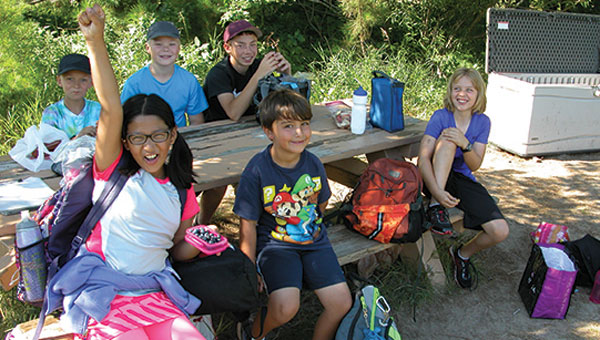
Camp activities included swimming, hiking, games, arts & crafts, horseback riding, cookouts, bonfires, story-telling, & singing all in an outdoor atmosphere of caring and sharing.

The “core” of the camp was moved to the north side of Lake Bertram in 2004 to be closer to the beach and to use the chalet as an office and safety area. Also, in 2004 a 400 seat capacity amphitheater was built by the Chalet by AmeriCorps, the Tree Trust, and YMCA volunteers including staff and the “Y’s” Men.

Many children from Monticello area attend the camp and many teenagers ended up being camp “counselors”. A story from one of these “counselors” will come later.

Jim’s History Corner – Camp Stories


Most of us have experienced sitting around a campfire with a group of people listening to stories on a varied number of topics. Some of these include stories of mystery, ghosts and murder.

Hatchet Harry was one of these stories. The Hatchet Harry story was born out of the YMCA Camp Maniteau before it ever moved to the Bertram Lakes area. (Earlier Tidbit) It is a story that has been embellished over a great number of years by a number of storytellers. Each addition usually can be attributed to some unexplained (or natural) occurrence that people have encountered at the camp.

One such adaptation has been the inclusion of the Black Cat to the story. Because there were 9 farmsteads that comprised the Bertram Lakes area, barn cats were a common occurrence and by coincidence many of them were black. When Monticello High school programs used the Chalet it was not uncommon to have a black cat stop by for a visit or watched from the woods.

So, the next time you’re at the Park and you see a black cat, please remember it’s … just a story.

Get Updates from Friends!

Our Lakes are Beautiful!

We appreciate your support!!